Quick Answer: No, they are not separate disciplines. SEO (search engine optimization) earns rankings in search results. AEO (answer engine optimization) aims to be the direct answer. GEO (generative engine optimization) aims to be cited in AI-generated responses. Google’s 2026 guidance states that optimizing for its AI features “is still SEO.” Good SEO is good AEO and GEO.
If you own a dental practice, someone has probably tried to sell you “GEO” or “AEO” this year. The pitch: SEO is dead, and you need a new service to show up in ChatGPT and Google’s AI Overviews.
Running a dental practice? Check my website for free →
As a dentist who also does SEO, this reminds me of the plaque-versus-biofilm debate. The newer term describes the problem more precisely. But the treatment never changed: disrupt it, mechanically, every day. GEO vs SEO works the same way, and Google has now said so in writing.
Key takeaways
- AEO and GEO are new labels for goals, not new rulebooks. For Google, the work is SEO.
- Google says you can skip llms.txt files, content “chunking,” AI-only rewrites, and special schema.
- What earns AI citations is what earns rankings: original, expert content on a crawlable, indexable site.
- For a dental practice, that means real clinical expertise, a complete Google Business Profile, and fast, clear service pages.
- ChatGPT and Perplexity may weigh signals differently; Google’s guidance covers Google only.
SEO vs AEO vs GEO: what each term means
The three terms describe where your content shows up, not three different ways to earn it. Here is how they line up for a dental practice.
| SEO | AEO | GEO | |
|---|---|---|---|
| Stands for | Search engine optimization | Answer engine optimization | Generative engine optimization |
| Goal | Rank in search results and earn the click | Be the direct answer to a question | Be cited or summarized in an AI response |
| Where it shows | Google and Bing results, Maps, local pack | Featured snippets, People Also Ask, voice assistants | Google AI Overviews and AI Mode, ChatGPT, Perplexity, Gemini, Copilot |
| Dental example query | “dentist near me” | “how long does a root canal take” | “Which dentist in Austin is good for anxious patients?” |
| What earns it | Helpful content, technical health, links, local signals | Clear, direct answers from a credible source | The same, plus being the source AI systems retrieve |
| How Google sees it | SEO | Part of SEO | Part of SEO |
AEO vs SEO
AEO grew out of featured snippets and voice search. It asks one thing: does your page answer the question cleanly, near the top, in plain words? That has been good SEO practice for over a decade. A root canal page that answers “Does a root canal hurt?” in its first two sentences serves the patient, the snippet, and the AI summary at once. On my patient-education site, The Calm Dentist, the guide to how long a root canal takes opens with the direct answer before the detail.
GEO vs SEO
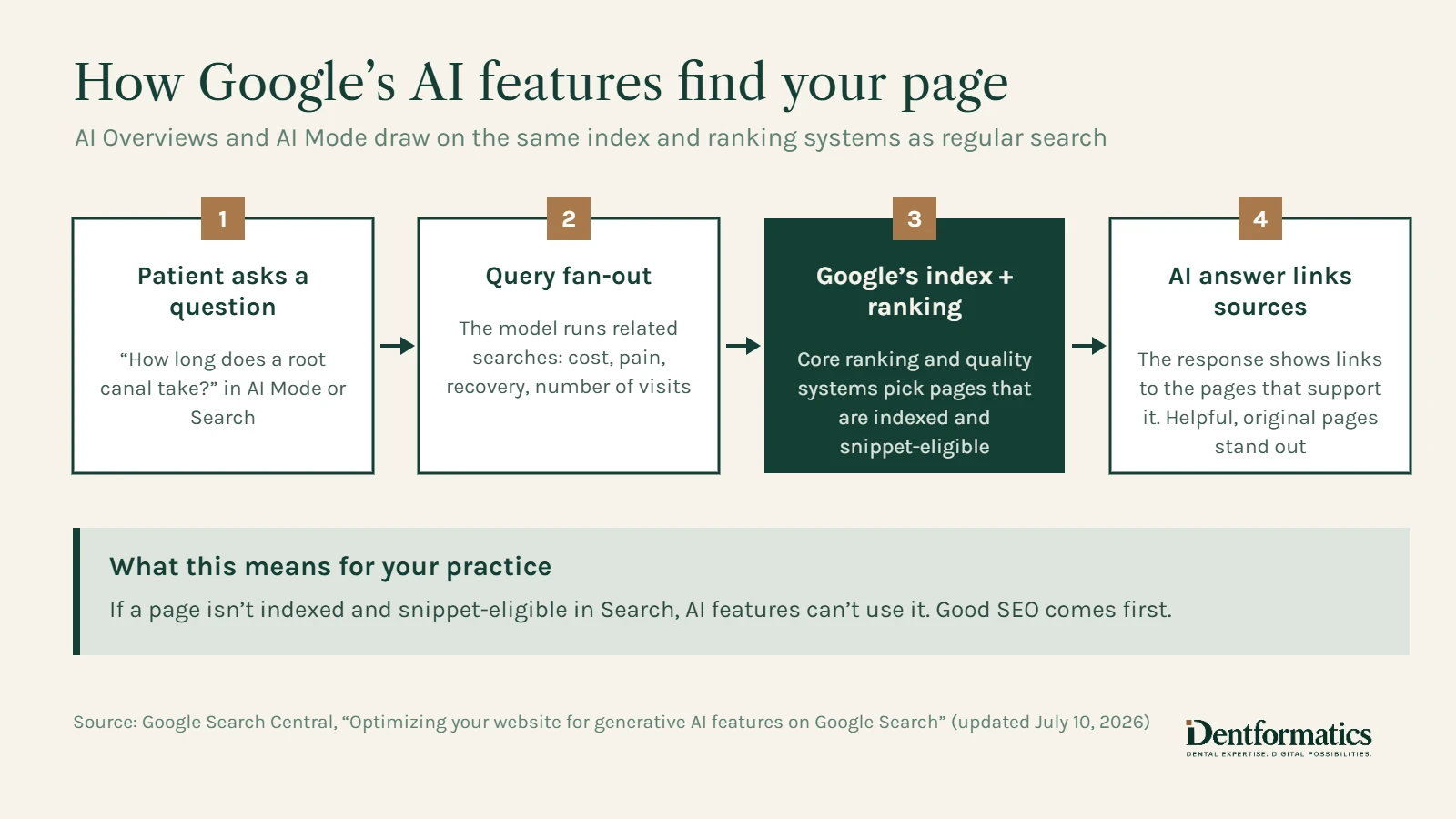
GEO is the newest label. It covers visibility inside AI-written answers. Google explains that its AI features use retrieval-augmented generation and “query fan-out”: the model runs several related searches and draws on pages from Google’s own index. So the page has to be indexed and rank-worthy before AI can use it.
A quick naming warning
“GEO” also means geo-targeting in local marketing. When we ran “geo vs seo” through AnswerThePublic, most AI prompts read it as geographic targeting. If an agency pitches “GEO,” ask which one they mean.
What Google says about GEO and AEO in 2026
Google’s position is now on record in its own documentation: for Google Search, AEO and GEO are SEO.
On May 15, 2026, Google’s John Mueller announced a new Search Central guide, Optimizing your website for generative AI features on Google Search. It was last updated on July 10, 2026. Three lines matter most for practice owners.
- AI features run on the same systems. Google says its AI features are “rooted in our core Search ranking and quality systems.” AI Overviews and AI Mode pull from the same index that ranks your pages.
- AEO and GEO are named directly. Google defines both terms, then concludes that optimizing for generative AI search “is still SEO.”
- The entry ticket is ordinary. A page must be indexed and eligible to show in Search with a snippet. The site must also be included in Search generative AI features in Search Console.
A companion page, Guidance on third-party SEO tools and advice (updated June 5, 2026), lists “AEO” and “GEO” tools among services to check carefully. Its warning is plain: no tool or service can guarantee rankings.
“Good SEO is good GEO”
The guide made official what Google’s Danny Sullivan said at WordCamp US on August 28, 2025: “Good SEO is good GEO, or AEO, AIO, LLM SEO” (Search Engine Land). His point was that SEO was never only about blue links. It means understanding how people search and making sure your content is there, wherever “there” is.
Not everyone agrees. Some analysts argue that AI answers reduce clicks, so how you measure success has to change. That is fair. But changing the scoreboard is not the same as changing the game.
What to stop paying for, and what to do instead
Google’s guide includes a “mythbusting” section listing tactics you can ignore for Google Search. If a GEO package is built on these, it is selling you nothing Google uses. Before you compare quotes, see what dental SEO should cost.
| Common “GEO/AEO” tactic | What Google says | What to do instead |
|---|---|---|
| Create an llms.txt or other AI file | Google Search ignores it; it neither helps nor harms | Keep your sitemap and robots.txt correct |
| “Chunk” pages into tiny pieces for AI | Not required; there is no ideal page length | Write each page for the patient reading it |
| Rewrite content just for AI | Not needed; AI understands synonyms and meaning | Write clearly, in patients’ own words |
| Buy or seed “mentions” | Inauthentic mentions are not as helpful as they seem; spam systems apply | Earn real reviews and local press |
| Add special AI schema | No special schema exists for AI search | Use standard schema for rich results |
| Spin a page for every query variation | Can breach Google’s scaled content abuse policy | One strong page per real patient need |
A fair question: this post uses a Quick Answer box and FAQ schema. Isn’t that “AEO”? It is just good writing. The answer box helps a skimming reader, and FAQ markup is standard structured data. Neither is required for AI features.
What actually earns visibility for a dental practice
Google says creating unique, useful content will likely matter more than any other step. It calls generic, common-knowledge pages “commodity content.” Here is what that looks like in dentistry.
- Write non-commodity content. “5 Tips for Whiter Teeth” could come from anyone. “Why Our Practice Stopped Recommending Charcoal Toothpaste” carries a clinician’s judgment. AI systems compare many sources, so a distinct expert view stands out. This is the core of our dental content writing service.
- Show who is behind the advice. Name the dentist, their qualifications, and their clinical experience on every treatment page.
- Fix the technical basics. Pages must be crawlable and indexable, load fast, and work on phones. Verify your site in Search Console. Our free dental website audit tool checks the essentials, and the SEO for dentists checklist covers the rest.
- Complete your Google Business Profile. Google names Business Profiles as a way to appear in AI responses and other results. See our guide to local SEO for dentists.
- Add real images and video. A short video of your sterilization setup or a before-and-after (with consent) gives AI features something to show beyond a link.
- Answer patients’ actual questions. Use the words they use: “Does a crown hurt?” not “Crown procedure discomfort management.”
How to measure visibility in AI search
Start with Google’s own data, not a third-party “AI visibility score.” Google points site owners to the Generative AI performance report in Search Console. It shows how people find your content through AI features in Search and Discover.
Google also warns that no third-party tool can see its internal ranking or AI systems. Tools that track mentions in ChatGPT can still be useful. Just treat their numbers as estimates, not Google data.
What about ChatGPT, Perplexity, and Copilot?
Google’s guidance covers Google only. Other AI platforms may weigh signals differently. Even so, Microsoft’s Bing documentation says SEO fundamentals support eligibility for its AI experiences. A crawlable site with expert, original answers is the best bet across all of them.
Does the AI content debate change this?
No. Google judges content by its quality, not by who or what typed it. We covered this in AI vs. human-written dental website content.
The bottom line for practice owners
GEO vs SEO is a debate about labels. For Google, the work is the same: an indexable site, fast pages, and content only your practice could have written. Spend your budget there before any “AI optimization” add-on. Our free dental SEO checklist is a good place to start.
Not sure where your site stands? Run our free dental website audit, or see our dental SEO service and book a call. I will review your site for both search results and AI features. Every review is done by a dentist who understands both the clinical content and the SEO.
Frequently asked questions
What is the difference between SEO and AEO?
SEO aims to rank your pages in search results and earn clicks. AEO aims to make your content the direct answer, such as a featured snippet or voice response. In practice they overlap almost completely. A dental page that answers a patient’s question clearly, near the top, from a credible source, serves both goals at once.
Is GEO replacing SEO?
No. Google’s 2026 guidance says its AI features are built on its core ranking systems and that optimizing for them “is still SEO.” GEO describes a new place your content can appear, inside AI answers. It does not replace the work that gets you there: crawlable pages, strong local signals, and original expert content.
Are AEO and GEO the same thing?
They are close cousins. AEO grew from featured snippets and voice search. GEO refers to citations in AI-generated answers from tools like ChatGPT and Google AI Mode. Some vendors use the terms interchangeably. Google defines both and treats both as part of SEO, so the label matters less than the content.
Do I need an llms.txt file for my dental website?
Not for Google. Google states that Google Search ignores llms.txt files, so they neither help nor harm your visibility there. Some other AI services may read them. If an agency charges you to create one, treat it as an optional extra, not as a core ranking task.
How can my dental practice show up in AI Overviews?
Make sure your pages are indexed and eligible for snippets, and that your site is included in Search generative AI features in Search Console. Then publish original, dentist-written answers to real patient questions, keep your Google Business Profile complete, and fix speed and mobile issues. There is no special switch beyond good SEO.
Is SEO still worth it in 2026?
Yes. Google’s AI features pull from the same search index and ranking systems as regular results. A practice that invests in SEO is also investing in visibility inside AI Overviews and AI Mode. What changes is measurement: also track the Generative AI performance report in Search Console, not just clicks.
Sources
- Optimizing your website for generative AI features on Google Search, Google Search Central (updated July 10, 2026)
- Guidance on third-party SEO tools and advice, Google Search Central (updated June 5, 2026)
- Google’s Danny Sullivan: ‘Good SEO is good GEO’, Search Engine Land (September 2, 2025)
- Google’s New AI Search Guide Calls AEO And GEO ‘Still SEO’, Search Engine Journal