Quick Answer: No, not simply because AI was used. Google says appropriate use of AI is not against its guidelines. What it targets is content made mainly to manipulate rankings, especially large volumes of unoriginal pages. For a dental website, use AI for research and drafting, and have a person check every clinical detail before publishing.
If AI helps write your dental website content, will Google penalize your practice? Not simply because AI was used. Google says appropriate AI use is not against its guidelines. Its concern is content created primarily to manipulate Search, especially large volumes of unoriginal pages that add little or no value. Google’s guidance focuses on quality and purpose, not whether a person or a tool produced the words.
Exploring AI or software for your practice? Explore software & AI help →
That is reassuring, but it is not a promise that every AI-assisted page will rank—or even be indexed. Dental content also needs careful human review because inaccuracies can mislead people making health decisions. The practical approach is to use AI for research support and repetitive work, then apply your own SEO checks, clinical judgment and editorial oversight before publishing.
Does Google penalize AI-written content?
Google does not have a blanket ban on AI-written content. Its published guidance says AI-generated content can appear in Search when it is helpful, reliable and created for people. Using AI does not give a page a special ranking boost either. It is evaluated like other content against Google’s Search Essentials and spam policies. (Google Search Central)
The important distinction is the reason and result. AI used to organize research, develop an outline or help improve clarity can be part of a responsible workflow. AI used to mass-produce pages mainly to capture rankings, without original insight or editorial review, can become scaled content abuse. Google’s policy applies whether the pages were made by AI, people or a combination of both. (Google’s scaled content policy)
A manual action is also different from a page simply failing to rank or being left out of the index. A decline in visibility does not, by itself, prove that Google penalized a page for AI. Check Search Console for a manual action and investigate technical issues, content quality, competition and indexing status separately.
What the available data says about AI content ranking
Google’s written policy is the clearest evidence that AI use alone is not prohibited. Independent SEO datasets also show that pages estimated to contain substantial AI text can appear in Google results. They do not show that AI content is equally effective in every case, or prove what caused a page to rank.
Ahrefs’ July 2025 study analyzed 600,000 pages available from the top 20 results for 100,000 keywords. Its detector classified 86.5% as containing some AI text, including mixed human/AI content. The correlation between estimated AI content and ranking position was 0.011, effectively zero. (Study and methodology)
A July 2026 follow-up found that 5.3% of the analyzed top-three pages were classified as fully AI-generated. It also reported estimated indexation rates of 49.28% for low-AI pages and 40.35% for very-high-AI pages. Its ranking analysis used around 150,000 pages with sufficient text from a much larger initial URL collection. (2026 study)
These are observational studies using an imperfect AI detector, not verified authorship records or controlled tests of Google’s algorithm. The first study examined pages already ranking; it cannot establish the success rate of all AI content. Neither study is specific to dentistry. They support a narrower conclusion: AI-heavy pages can rank and be indexed. They do not show that AI and human writing perform equally, or that AI use caused any outcome.
Why dental content needs a human in the loop
Dental website content can influence a person’s understanding of treatment, risks, costs and next steps. Google identifies health-related topics as areas where reliable information matters especially. Its AI content guidance calls for manual fact-checking and review of AI-generated content, including titles, descriptions, structured data and image text.
A human reviewer can catch problems that an AI draft may miss, such as:
- A treatment description that sounds universal when suitability depends on an examination.
- A risk, recovery period or result presented as certain when it varies by person.
- Outdated advice, invented citations or a source that does not support the claim.
- Differences in clinical terminology, local standards or the services a practice actually provides.
- Generic copy that could describe any clinic and gives readers no useful reason to trust the page.
A clinician’s review should be genuine and documented. Do not add a “reviewed by” label unless a qualified person has actually reviewed the final copy. Use accurate author details and link to relevant credentials when appropriate. Avoid placing identifiable patient details into public AI tools unless your practice has confirmed that the tool and workflow meet its privacy and contractual requirements.
What human oversight changes in a dental draft
Consider this illustrative AI draft: “Dental implants are a painless, permanent solution suitable for everyone.” A fluent sentence can still contain several misleading claims. Before publication, a dental reviewer would need to check the comfort claim, expected longevity and suitability against evidence and the practice’s actual treatment process.
The editorial task is more than replacing a few words. It includes identifying what an individual assessment determines, explaining uncertainty and making sure the page does not promise a result the practice cannot guarantee. A human writer needs the same scrutiny; authorship alone does not establish accuracy.
This is where dental content writing by a dentist can help: translating clinical detail into language your intended readers can understand, while keeping claims proportionate to the evidence.
Does publishing lots of content trigger a Google penalty?
Google does not publish a safe number of posts per week or month. Frequency alone is not the policy test. The risk is publishing many pages primarily to manipulate rankings, especially if they repeat one another, repackage existing sources or provide little original value. Google calls this scaled content abuse and says it can apply whether the content is generated by AI, by humans or both. (Google spam policies)
For a dental practice, set your publishing pace by the time available to research, personalize, review and maintain each page. Before adding another article, ask:
- Does it answer a real question from our patients or prospective patients?
- Does it add a useful explanation, practice-specific detail or expert insight beyond pages already available?
- Are its claims and references checked by a suitable human reviewer?
- Does it have a clear place in the site’s structure, with relevant internal links?
- Can we keep it accurate as services, evidence and guidance change?
If you cannot review a page properly, hold it. A smaller set of complete, distinct pages is easier to maintain than a large archive of near-duplicates.
Will good content always be indexed?
No. Good content improves your chances of being useful and eligible, but Google does not guarantee that any page will be crawled, indexed or shown. A page can be missing for reasons unrelated to AI, including technical access problems, weak discovery links, duplication or other indexing decisions. A sitemap or indexing request can help Google discover a URL, but neither guarantees inclusion. (Google’s crawling and indexing FAQ)
So the accurate version is: Google can index and rank content whether AI or a person helped write it, but it does not promise to index every good page. “Not indexed” is not automatically the same as a penalty. Check the URL Inspection and Page Indexing reports, verify the page is accessible to Googlebot and review any Search Console manual action notification.
A safer AI-assisted workflow for dental websites
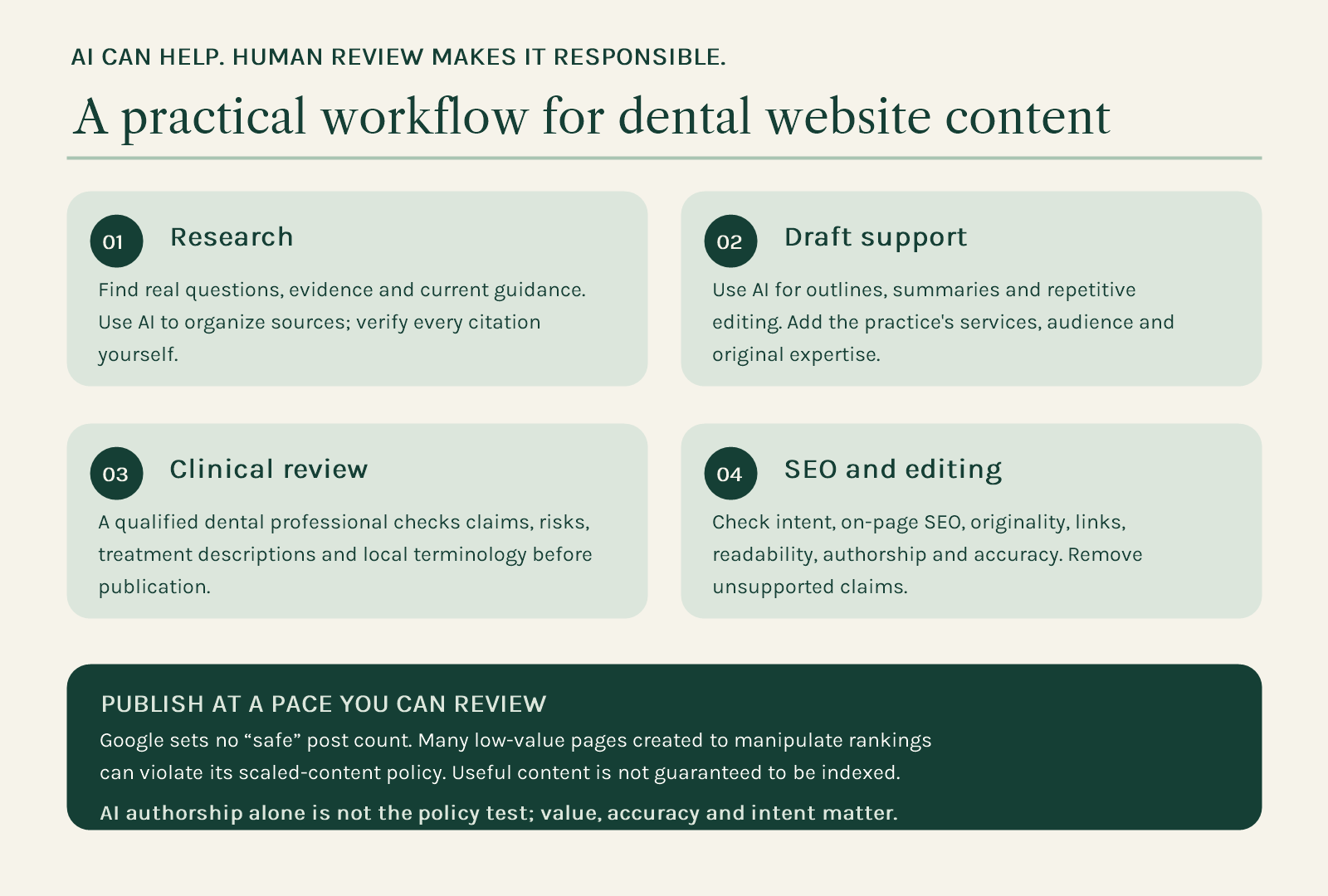
Use AI as an assistant for the work that benefits from speed and structure, not as the final authority.
1. Start with a real reader need. Use search data, patient questions and the practice’s service priorities to decide what to write. Don’t publish a page solely because a tool produced a keyword list.
2. Research from sources you can verify. AI can help locate questions, summarize supplied documents or organize an outline. Open the source material yourself. Confirm that each source exists, is current and supports the statement attached to it.
3. Add real expertise and context. Include the practice’s actual services, audience, location and process. Explain what varies between patients and when an examination or professional advice is needed. Do not invent outcomes, case examples or testimonials.
4. Get the right human review. Have a qualified dental professional check clinical statements and a responsible editor check clarity, originality, claims, references and brand fit. Where appropriate, identify the author and reviewer accurately.
5. Do the SEO and technical checks. Match the page to search intent; write a useful title and heading structure; add relevant internal links; check mobile readability, page access, canonical settings and indexability; and ensure image alt text describes the image. SEO helps search engines understand a page, but it cannot guarantee a ranking or indexation.
6. Publish when it is ready, then monitor it. There is no need to rush pages into a bulk schedule. Track crawling, indexing, impressions, clicks and reader response. Update content when the facts or practice information change.
A practical division of work
| AI can help with | A human should own |
|---|---|
| Topic clustering, outline options and summarizing supplied sources | Choosing the right topic and confirming source accuracy |
| First drafts, formatting and repetitive edits | Clinical accuracy, nuance and practice-specific facts |
| Finding questions to address and checking for missing sections | Final claims, references, author/reviewer details and publication decision |
| Drafting metadata and alt-text options | Reviewing metadata, accessibility and the actual image |
What this means for your dental practice
You do not need to avoid AI to protect your dental website from a supposed automatic “AI content penalty.” Google’s guidance does not ban AI authorship, and independent research has found AI-heavy pages in search results. The real risks are unhelpful or repetitive content, ranking-first mass production, unsupported claims and inadequate review.
Use AI for research assistance, outlines and routine drafting. Then verify every important point, add genuine dental expertise, complete your SEO and technical checks, and publish at a pace your team can review. This reduces avoidable policy and accuracy risks—but no writer can promise that every page will be indexed or rank.
If you want a second set of eyes on your site, start with the free dental website audit tool or learn more about Dentformatics’ dental content writing and dental SEO services.
Frequently asked questions
Does Google penalize AI-written dental website content?
AI use alone is not a policy violation. Google permits appropriate use; content created primarily to manipulate rankings can violate its spam policies.
Can AI-written dental content rank on Google?
Yes. The studies discussed above found AI-heavy pages in search results. Their detector-based findings do not guarantee results for a dental website.
Will good SEO and clinical review guarantee indexing?
No. These checks reduce avoidable problems, but Google does not guarantee crawling, indexing or rankings for any page.
How many AI-assisted articles can a practice publish safely?
Google gives no safe post count. Publish only as many distinct, useful pages as your team can properly research, review and maintain.
Should we rewrite content to pass an AI detector?
A detector score cannot establish clinical accuracy or compliance with Google’s policies. Edit for evidence, originality, clarity and reader needs instead.
Can AI replace a dental content writer or clinical reviewer?
AI can support research organization, outlines and routine edits. A responsible human must verify sources, clinical claims, practice details and the final publication.
What should we check if an AI-assisted page is not indexed?
Inspect the URL in Search Console. Review crawl access, indexing directives, canonical settings, internal links and duplication, and check the Manual Actions report.
References
- Google Search’s guidance on AI-generated content
- Google’s guidance on using generative AI content on your website
- Google spam policies: scaled content abuse
- Google crawling and indexing FAQ
- Ahrefs: AI-Generated Content Does Not Hurt Your Google Rankings (July 2025)
- Ahrefs: Google Doesn’t Punish AI Content; It Punishes Bad Content (July 2026)